
July 23, 2025
-min.JPG)
Maui County marked a major milestone for health and wellness on July 7 with the launch of two new Fitness Court Studios—one at Keōpūolani Regional Park and another at Kahului Community Center Park. The blessing and ribbon-cutting ceremony celebrated the island’s first installations of the signature outdoor wellness platform and only the second and third Fitness Courts ever to open in the state of Hawaiʻi.
The Fitness Courts were developed through a partnership between the County of Maui, Hawai‘i Medical Service Association (HMSA), and National Fitness Campaign (NFC), with support from Maui Public Art Corps. Designed to provide free access to high-quality outdoor exercise for users of all abilities, each Fitness Court Studio includes seven bodyweight training stations and connects to a free mobile app that offers guided workouts and digital wellness coaching.
.JPG)
“This is a significant milestone for our community’s commitment to health and wellness,” said Mayor Richard Bissen. “These state-of-the-art facilities provide an accessible, welcoming space where residents can engage in physical activity, build strength and improve overall well-being. By investing in fitness infrastructure, we are not only promoting healthier lifestyles but also fostering a stronger, more vibrant community. Mahalo to HMSA and NFC for bringing the Fitness Courts to Maui and empowering our people to take charge of their health.”
.jpg)
.JPG)
A blessing ceremony, led by Uncle Bill Garcia of the Royal Order of Kamehameha and Kākalaleo for Nā Hanona Kūlike O Piʻilani, took place at Keōpūolani Regional Park on the morning of July 7th.
HMSA also emphasized the importance of community connection in its mission to expand access to healthy living resources.
“HMSA is excited to bring the Fitness Courts to the Kahului community, creating a welcoming space where Maui residents can come together to stay active, healthy, and connected,” said Jennifer Diesman, HMSA senior vice president, government policy and advocacy. “Our sincere thanks to Mayor Bissen and his team for their invaluable partnership and shared commitment to fostering healthier lifestyles in Maui.”
While many Fitness Courts across the country feature artwork, what sets the Maui installations apart is the custom, site-specific murals developed through a deeply collaborative public art process led by Maui Public Art Corps. The County of Maui chose to collaborate with community members and artists to create original pieces rooted in local culture, history, and sense of place.
At Keōpūolani Regional Park, Maui-based digital artist Courtney Holland spent months in conversation with community consultants, historians, and cultural leaders to inform her artwork. The mural centers around the koaʻe kea (white-tailed tropicbird) in flight, symbolizing past, present, and future through movement across the canvas.
“Listening to people tell their stories about Kahului has made me feel proud of where I come from,” said Courtney Holland. “Taking time to reflect on the information given from each community member, at first I was thinking more literally with every idea I had. I believe I had multiple ideas wanting to conjoin but never fully did. Being able to take a step back, I found a more focused idea I want to portray.”
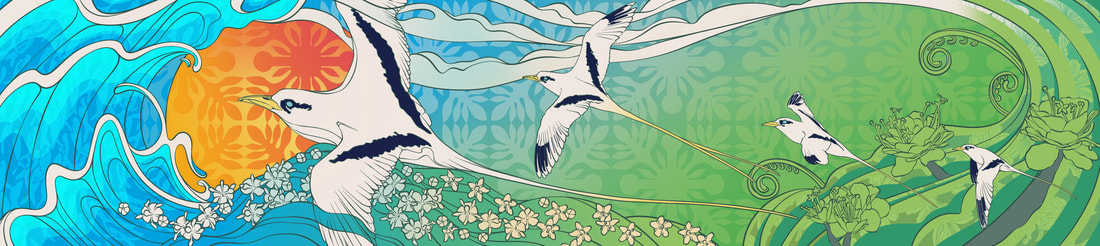
Her final composition integrates the heʻe (octopus), mountains (mauka), and sea (makai), as well as native plants and fish inspired by the park’s history as a raw fish camp. Holland said, “I wanted to encapsulate the idea of wanting to become a better person for the people that raised us as well as personal wellbeing.”
She credits local advisors—including Aunty Kekoa, whose stories reminded her of the aunties she grew up with—for shaping the direction of her work. “I did not want to incorporate them too literally,” Holland explained. “Wanting to interpret her husband’s stories as birds following one another... this created the main focus of my mural.”
The mural also includes plant life suggested by the Maui Nui Botanical Gardens and imagery reflecting a sense of gathering and interconnectedness. “I believe it is our way of saying thanks to the people that raised us and finding a better future for the community itself,” she said.
At the Kahului Community Center Park Fitness Court, muralist and landscape architect James Dinh, based in Los Angeles, brought a new lens to community storytelling—drawing deeply on the insights of local cultural practitioners and historians. Though new to Maui, Dinh worked closely with community consultants and the Maui Public Art Corps to develop a mural that reflects both the ecological uniqueness of the area and the cultural wisdom embedded in the land.
“The overall theme of the mural is the deep attachment that Hawaiians have to the land and nature,” James Dinh said. “The wave-like, weaving forms of the artwork express an interconnectedness between the various elements of the landscape, of which humans are an inseparable part.”
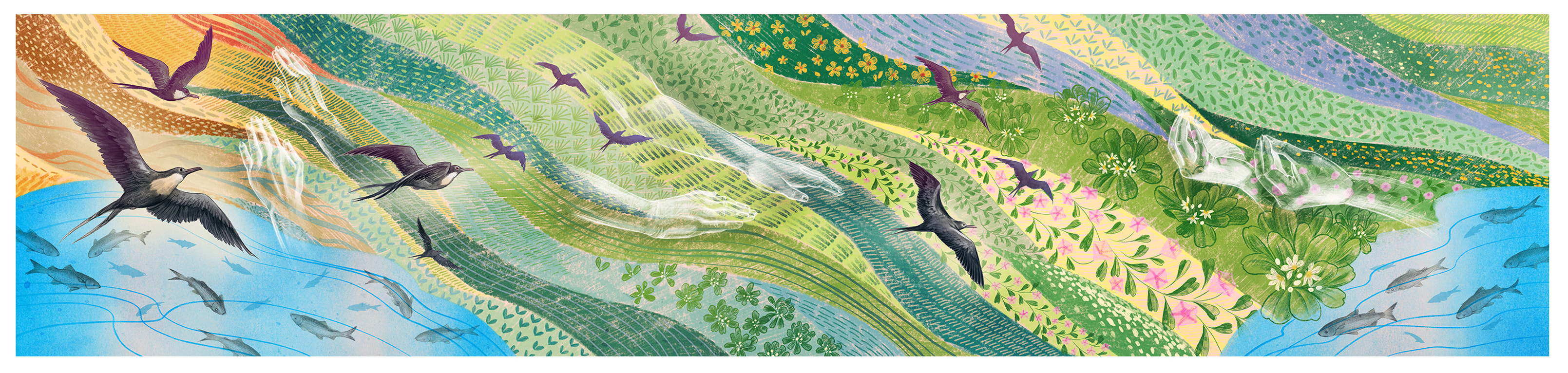
The mural features endemic plants such as pōhuehue and naupaka kahakai, as well as native species like the ‘iwa bird and the ‘ama‘ama fish, which historically thrived in the Kanahā fishponds that once existed nearby. “Hula hand gestures depicting aloha, ʻāina, and pua” were overlaid on the landscape, reinforcing the theme of connection between people and place. Dinh explained, “Aside from being a dance and a form of storytelling, hula is a practice through which Hawaiians connect with the natural world and ancestral wisdom.”
He noted how community feedback shaped the direction of the piece: “Sissy Lake-Farm demonstrated some hula hand gestures, which were traced and incorporated into the mural artwork.” He also highlighted contributions from Aunty Kekoa Enomoto, who described Kahului as once being covered in sand dunes—a detail that informed the mural’s desert-like palette and ecological references.
“As someone who has never been to Maui, the community engagement process was crucial for my learning about the landscape, culture, and history that are specific to Kahului,” said Dinh. “The insights generously provided by the consultants piqued my curiosity to engage in further research into different topics that I would otherwise never have thought about.”
The launch celebration at Keōpūolani included a traditional Hawaiian blessing, remarks from county, health, and campaign officials, and community members gathering to tour the artwork and try out the new Fitness Courts. Under the morning sun, local residents and visitors alike explored the free bodyweight stations and admired the murals—now permanent fixtures of Central Maui’s public landscape.
-min.JPG)
-min.JPG)
"We are excited to have the County of Maui join us in the journey to improve health and wellness,” said Mitch Menaged, founder of National Fitness Campaign. “The addition of the outdoor Fitness Courts, along with digital wellness programming, demonstrates a tremendous commitment to the health and well-being within the community.”
With its blend of free access to exercise, digital wellness tools, and culturally resonant public art, the Maui Fitness Court project is a model for how infrastructure can uplift not just bodies—but stories, identity, and community pride. As the second island in the state to join the National Fitness Campaign, Maui is now home to spaces where health, heritage, and artistry meet—where movement is both physical and cultural.


